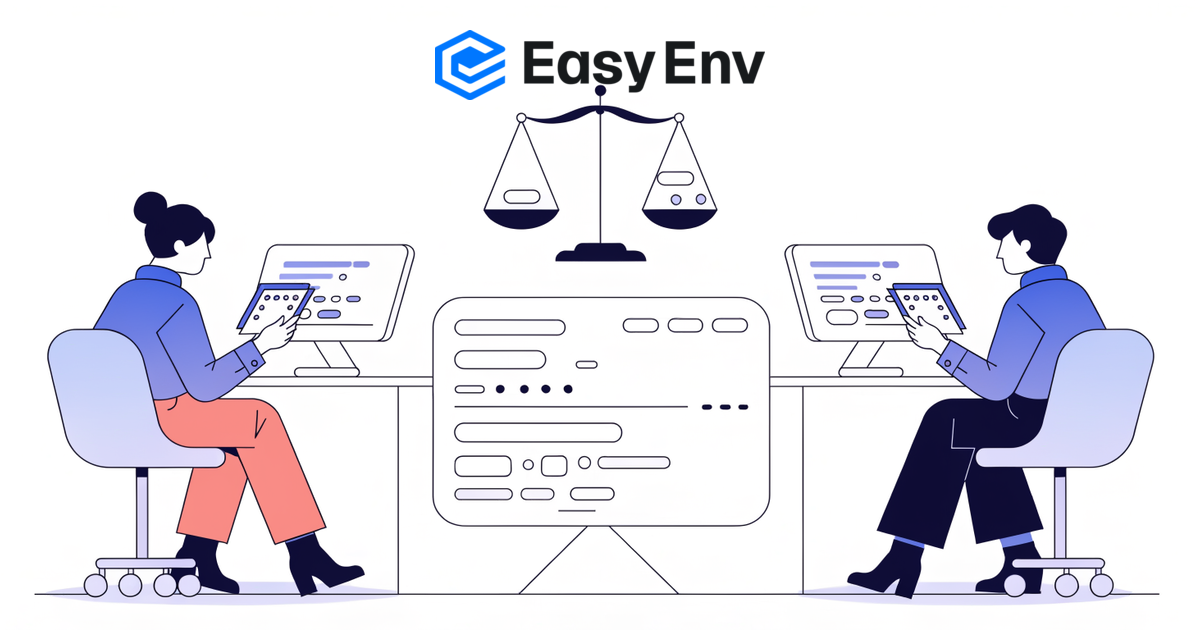
Two of your engineers interview the same candidate on the same day. One says strong hire. The other says no. Both are experienced, both are acting in good faith, and they watched the same person. When that happens, the honest conclusion is uncomfortable: your interview is not measuring the candidate reliably. It is measuring the interviewer.
Disagreement is not automatically bad. Sometimes two people genuinely saw different things and the conversation surfaces real signal. But most interviewer disagreement is drift, not insight, and drift is fixable. Here is where it comes from and how to close it.
Where scoring drift actually comes from
When interviewers reach different verdicts on the same candidate, the cause is usually one of a few structural problems, not a difference in judgment:
- Different questions. If each interviewer improvises their own problem, they are literally evaluating different things and then comparing scores as if they measured the same skill. They did not.
- Different bars. One interviewer's "solid" is another's "barely passed," because nobody ever defined what each level looks like. The scale exists only in each person's head.
- Different emphasis. One weights speed, another weights caution, a third weights communication. Without an agreed definition of what matters for the role, everyone optimizes their own preference.
- Unstructured evidence. When the only record is memory and a few notes, interviewers reconstruct the session through their own impressions. Two memories of the same hour diverge fast.
- Bias dressed as intuition. "Culture fit" and "seemed sharp" are where affinity bias hides. Unstructured gut calls are exactly where similar-to-me preferences slip in, which is the well-documented case for structure over intuition.
Notice that none of these are about the candidate. They are about the measurement instrument, which is the panel.
Structure is what makes interviewers agree
The research on this is consistent: structured interviews, where every candidate faces the same questions scored on the same predefined scale, predict job performance substantially better than unstructured ones, and they reduce bias because they leave less room for gut calls to stand in for evidence. (For a widely cited synthesis, see the classic meta-analytic work by Schmidt and Hunter on the predictive validity of selection methods.)
Structure is also what makes a panel converge. If two interviewers ask the same task and score against the same rubric, their disagreement shrinks to the parts that are genuinely debatable, which is exactly where you want the conversation to happen.
Concretely, calibration rests on three things:
- A shared task. Every candidate for a role does the same, or an equivalent, real exercise. Now scores are comparable because the thing being scored is the same.
- A shared rubric. Define what each level looks like in observable terms before anyone interviews. Not "good at debugging" but "reproduced the failure before editing, formed a hypothesis out loud, changed one thing at a time." We go deep on this in how to write a technical interview rubric.
- A shared record. When the session is recorded, disagreement stops being memory versus memory. Both interviewers can point at the same moment and say "this is what I mean," and one of them usually updates.
Calibrate the humans, not just the process
A rubric on paper does not calibrate a panel by itself. You have to actively align the people:
- Score independently, then compare. Have each interviewer commit a score before the debrief, so nobody anchors on the loudest voice. Then discuss the gaps. (This is the backbone of a debrief that actually decides, covered in the interview debrief that reaches a decision.)
- Review recorded sessions together. Periodically, have the panel watch the same recorded interview and score it independently, then reconcile. This is the single most effective calibration exercise, because it exposes exactly where two people read the same behavior differently.
- Treat large disagreements as data. A two-level split is a signal that either the rubric is ambiguous or one interviewer is off-scale. Investigate it instead of just averaging it away.
- Rotate and anchor new interviewers. New panelists calibrate fastest by scoring recorded sessions against the rubric and comparing to the consensus, before they ever sit in a live one.
Why recorded, real-environment sessions make this practical
You cannot re-watch a whiteboard. Calibration that depends on recordings needs sessions that are actually captured and reviewable.
EasyEnv runs candidates in a real environment on a shared task and records the whole thing: the terminal, the edits, the order it happened. That recording is what makes panel calibration possible in practice. Interviewers can review the same evidence, new panelists can train against past sessions, and a disagreement becomes a specific moment two people can rewind to, rather than a clash of impressions. The measurement instrument gets more reliable over time, which is the entire point.
The takeaway
When your interviewers disagree, suspect the measurement before the candidate. Same task, same rubric, same reviewable record, and independent scoring before debate. That is what turns a panel of individual opinions into a reliable instrument.
Calibrate the interviewers, and the disagreements that remain will finally be about the candidate.