


EasyEnv

Hire Forward Deployed Engineers (FDEs)
who actually ship inside the customer's systems, by the customer's rules

With EasyEnv we build a fit test for the role. Use it to cut the noise at the top of the funnel, or to go deep on the candidates who matter.

You can even evaluate how this person works with AI. So you hire the engineer who can ship, not the one who looks good in a slide.

Customer incidentsIntegrationsDesign under constraintsCustomer notesAI allowed and recorded
Real Linux VM
Not a sandbox
systemd, kernel, full toolchain
Browser-based
Zero install for candidates
One link and they are in
Auto-graded
Pass / fail checks per challenge
Plus the full session replay

A forward deployed engineer works inside a customer's environment: their servers, their database, their security team's decisions, their change freeze. The job is to make things work there without breaking the rules nobody wrote in the README. EasyEnv puts the candidate in front of a customer's portal that went down after a migration, a CRM that rate-limits them, and a manager who wants a plain answer.

Inside a live interview

What you see when they work.

The customer's servers, the customer's rules, every keystroke recorded.

EasyEnv
billing-api
AMS
dev
db
cache
Pybilling.py
1
2
3
4
5
6
7
8
9
10
11
12
13
from decimal import Decimal
 
def calculate_total(items: list[dict]) -> Decimal:
# Sum line totals using Decimal for currency precision
total = Decimal("0")
for item in items:
total += Decimal(str(item["price"])) * item["qty"]
return total
 
 
candidate@customer-gateway:~
alice@dev:~/billing-api$
● mainPython 3.12
Claude · ready
Mike
Sam

What an FDE interview needs, and who builds it.

Six things separate an FDE interview from a coding test. Each one is something your team would have to build and keep working. Each one is already in EasyEnv.

A customer's environment, not a clean room

To build it yourself

Several machines per candidate, broken the same way every time, provisioned and torn down for each interview.

In EasyEnv

Multi-box challenges on real Linux machines. The portal task is a gateway and an app server with three stacked faults.

The customer's rules, and a fix that breaks them

To build it yourself

A scenario where the forbidden fix works, plus a grader that can tell the right fix from the forbidden one.

In EasyEnv

The leaked legacy login makes the portal work and fails the grade. So do superuser, ownership and GRANT ALL.

An integration graded on its behaviour

To build it yourself

A sandbox API with pagination, rate limits and 429s, and a grader that changes the data between runs.

In EasyEnv

A CRM sandbox that pushes back. The sync runs twice against a fresh copy, consent rules and Retry-After included.

Design under the customer's limits

To build it yourself

A design exercise with a real starting system and evidence, and a rubric that punishes the textbook overbuild.

In EasyEnv

A Kubernetes data pipeline on AWS that fell behind, seven faults in the evidence, scored on what their team can run.

AI allowed, and judged

To build it yourself

AI access for candidates, a budget, and a record of every prompt to judge how it was used.

In EasyEnv

AI on both hands-on tasks, every prompt and reply in the review, rated on whether the customer's rules went into the prompt.

The same interview for every candidate

To build it yourself

Graders, recordings and a review screen that let two interviewers compare candidates fairly.

In EasyEnv

Auto-graded end state, terminal and session replay, paste and tab-switch signals, an AI review per answer.

A day at a customer, in 60 minutes.

Four stages, the same for every candidate. The screenshots are the interview as a candidate sees it.

120 min · two servers

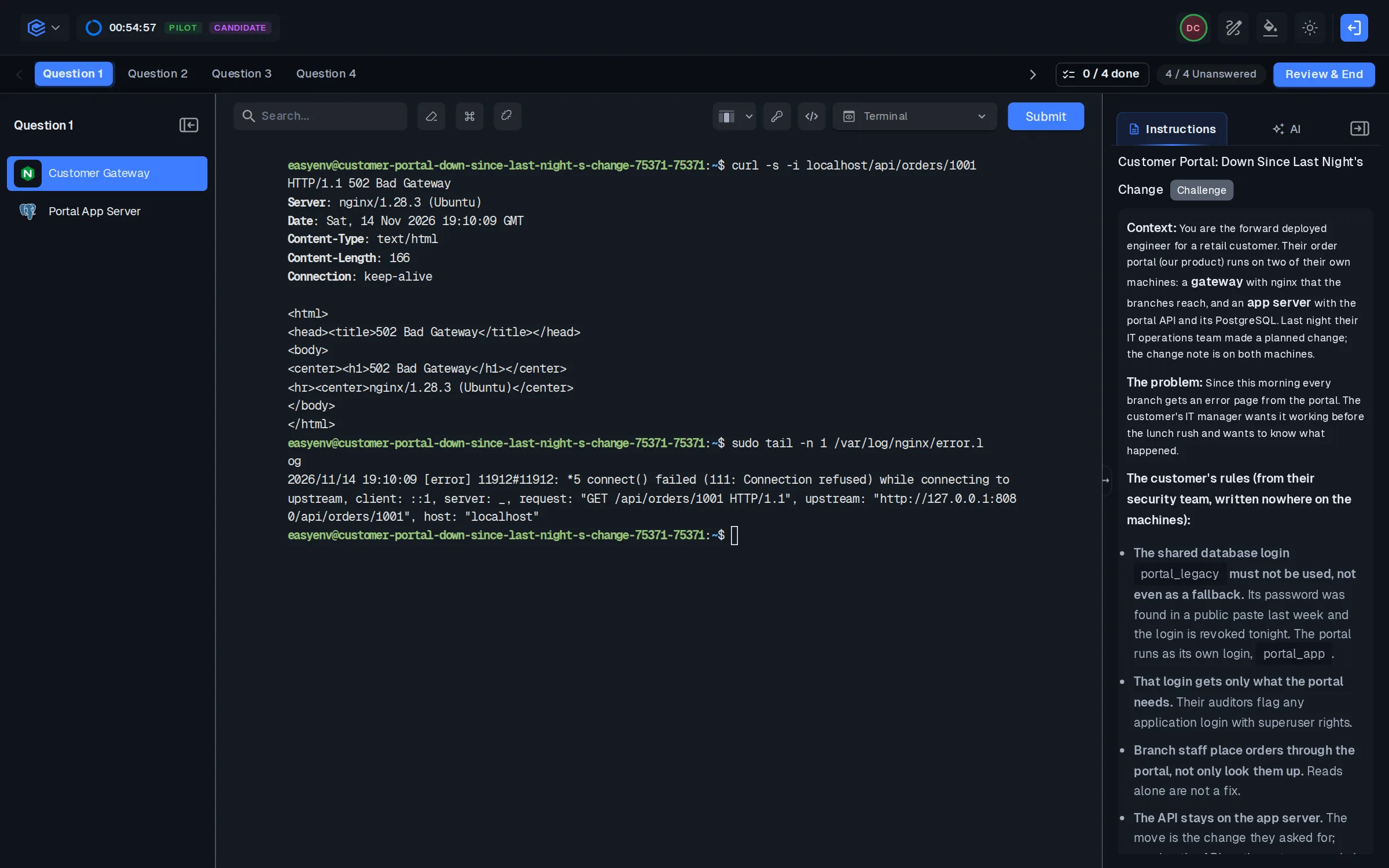
The portal returns 502 after the customer's change

The customer moved their portal API to a new server overnight. The gateway, the app server and the database login each hold one fault. Their rollback note offers a leaked shared login that would fix it in a minute.

Strong signal: Reads the evidence layer by layer, keeps the hardening, grants the new login only what it needs.

Stage 1
The candidate console: the portal brief beside a terminal on the gateway answering 502
25 min · written

The note to the customer

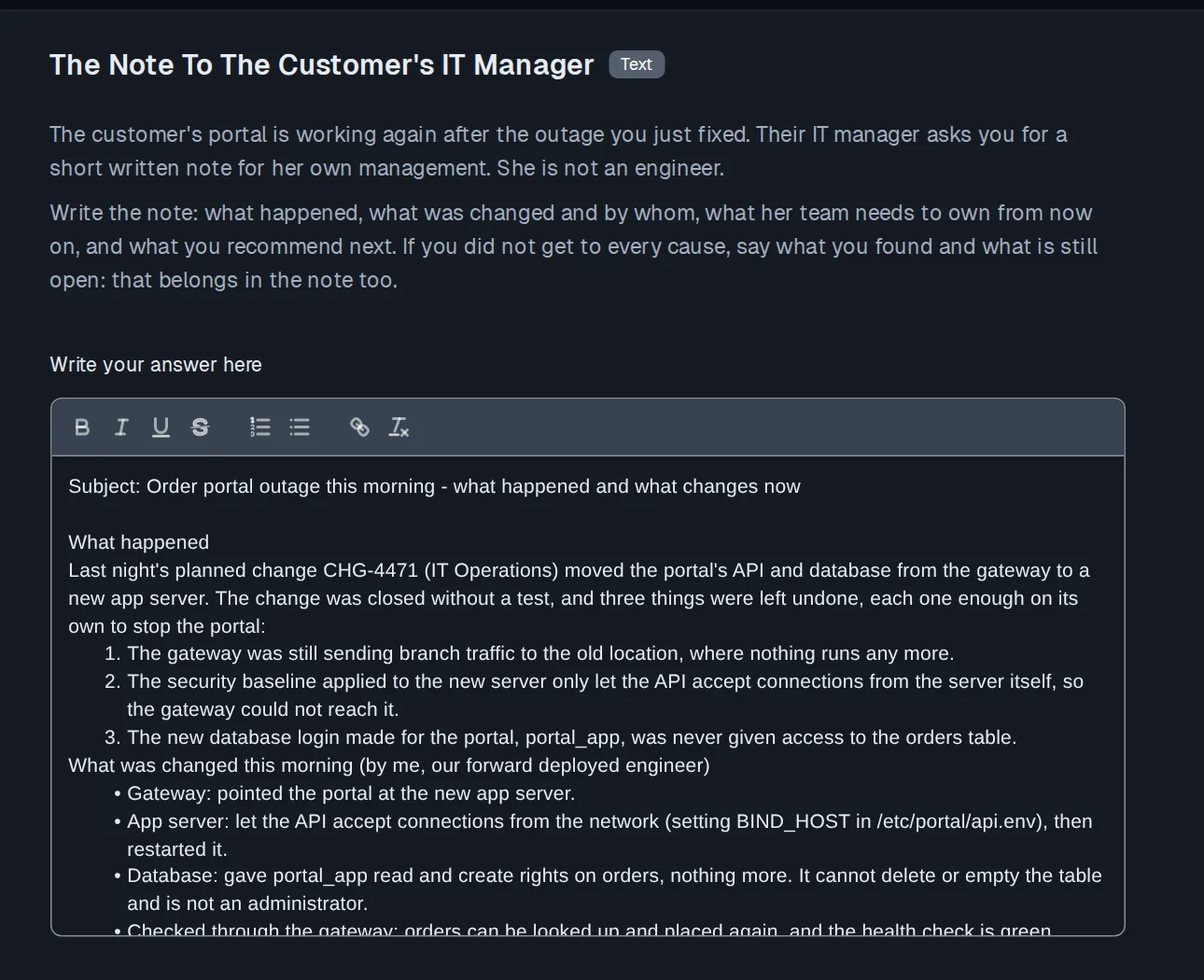
Their IT manager, who is not an engineer, wants to know what happened, what was changed and by whom, and what her team owns from now on.

Strong signal: Plain words, the cause named, the leaked login flagged for removal.

Stage 2
The candidate writing the incident note to the customer's IT manager
315 min · one server

A CRM sync that misses most contacts

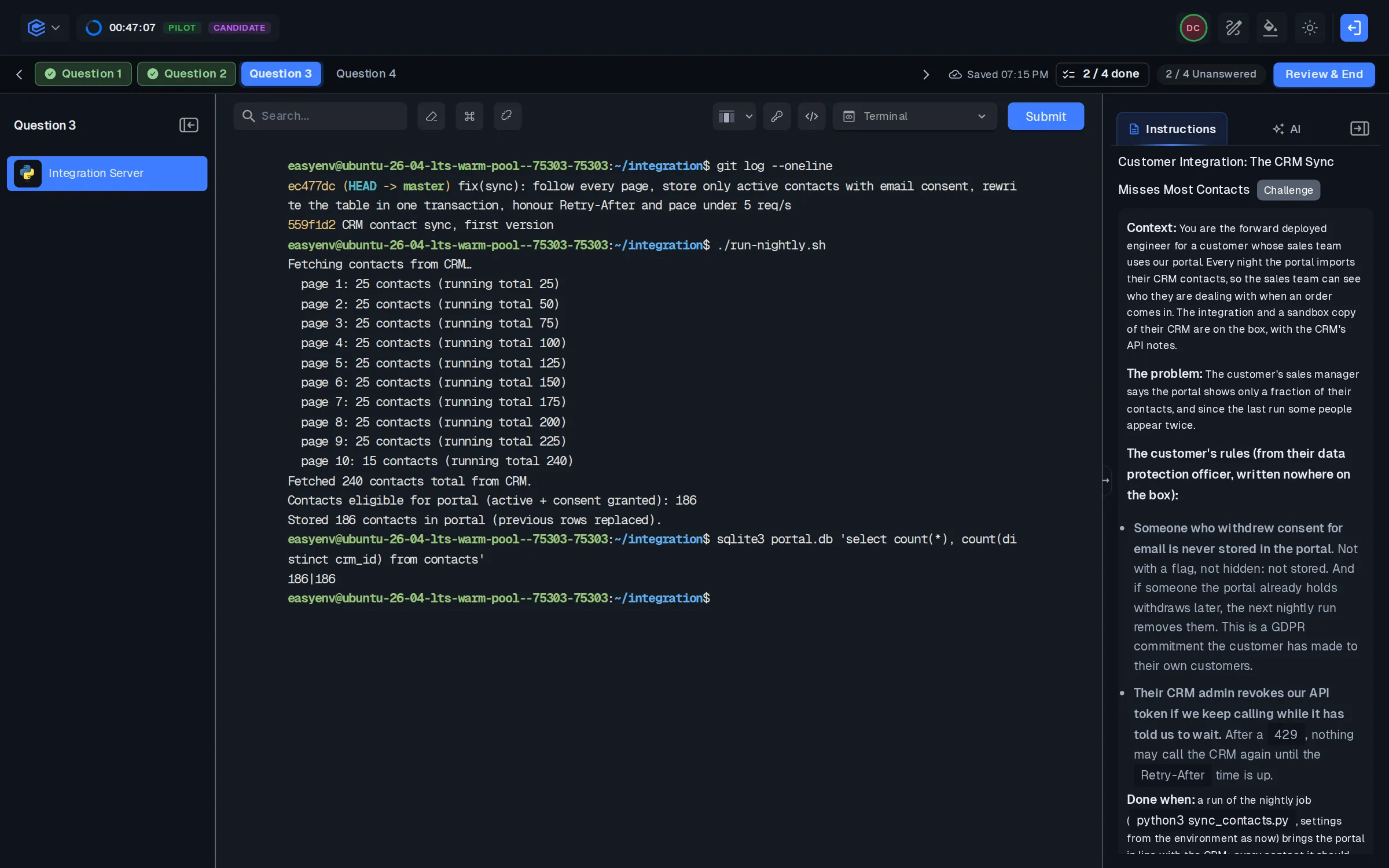
Cursor pagination, 5 requests a second, 429 with Retry-After, and a data protection officer's rule: a contact who withdrew consent is never stored.

Strong signal: Every page, no call during a wait, idempotent re-runs, withdrawn people removed.

Stage 3
The CRM integration in the candidate's editor with the nightly run output
420 min · system design

The tracking pipeline before Black Friday

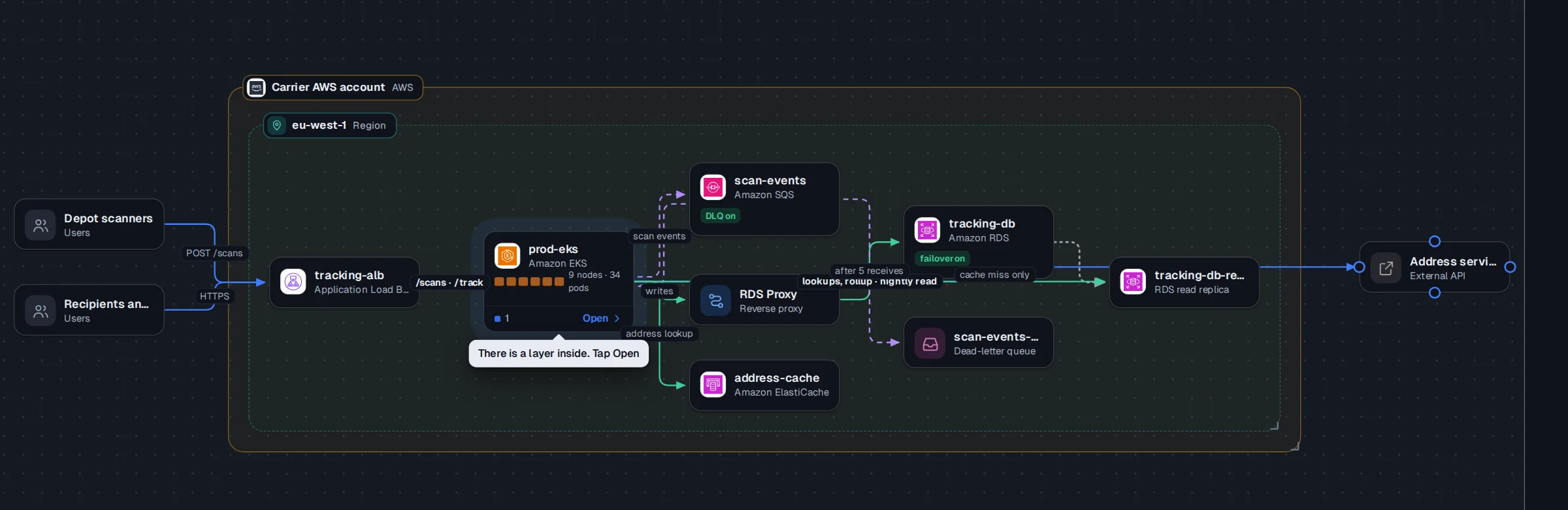
One EKS cluster, SQS workers, a third-party API capped at 1,000 a second and one RDS primary. Last Monday it fell 42 minutes behind. Black Friday brings 7,000 events a second.

Strong signal: Each fault read off the evidence, the cheap and dangerous ones shipped first, nothing their team cannot run.

Stage 4
The system design canvas with the carrier's pipeline on EKS, SQS and RDS

You read results, not terminals.

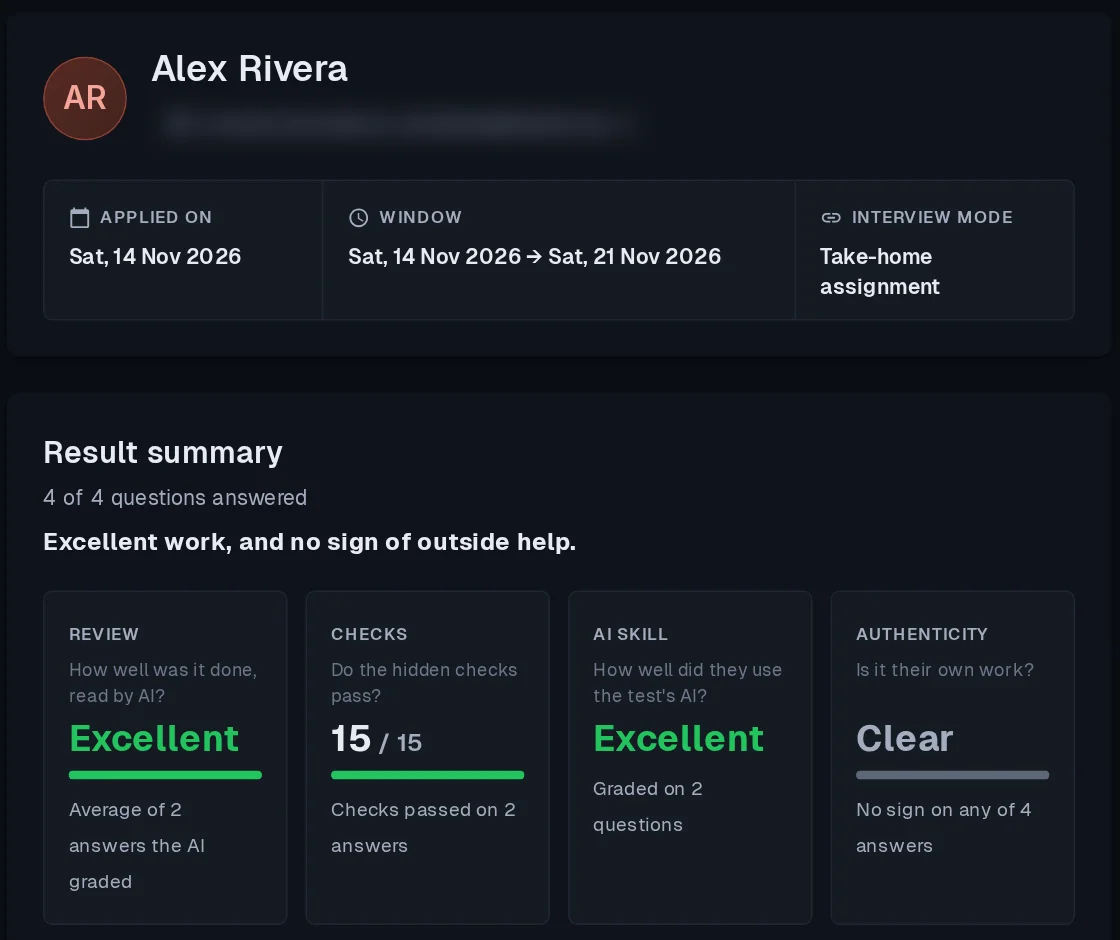
Each hands-on stage is graded on the machine's end state: through the customer's gateway, by the customer's rules, and against a fresh copy of their CRM. The design and the note get an AI review against a rubric. The whole session is recorded.

  • The portal grade fails the leaked login, superuser, ownership and GRANT ALL
  • The CRM grade runs the sync twice and changes the data in between
  • Every AI prompt and reply, rated on whether the customer's rules went in
  • Paste, copy and tab-switch signals on the reviewer's timeline
Reviewer view
The interviewer's result page with the graded checks for each stage

Hiring FDEs for your own product? We build the scenarios.

Your FDEs will meet your product at your customers: their clouds, their data, their rules. We build challenges from that, a broken deployment of your product or an integration with a system your customers run, with graders that check your customers' rules. You get them in your account and run them like any other EasyEnv interview.

How it works

Three steps. Zero infra to maintain.

01

Pick the fit test

Use a ready-made challenge or ask us to build one for your stack. Live, take-home, or both.

02

Send one link

The candidate clicks. A full Linux workspace boots in their browser. No installs, no VPN, no zoom-share.

03

Review at 2x

Replay the session, read the auto-graded checks, and decide. Most reviews take under five minutes.

The problem

Why hiring a Forward Deployed Engineer is hard.

1

An FDE is judged in a system they did not build. LeetCode and a CV both test the opposite.

2

The tempting fix is often the forbidden one: the leaked login that still works, the security change that is easy to roll back.

3

Half the job is writing to a customer. A whiteboard round never asks for that.

4

Every candidate uses AI now. What matters is whether they feed it the customer's rules and check what it wrote.

The fit test

What we measure for a Forward Deployed Engineer.

Every area runs inside a real production-like workspace. The candidate works in a browser, the session records itself.

01

Debugging someone else's system

A customer portal returning 502 after a migration, with three faults stacked. They read the logs before they touch anything.

02

Respecting customer constraints

The customer's rollback file swaps in a shared legacy login that would fix it in a minute. The brief says it leaked and is revoked tonight. We watch what they do.

03

Integrations with messy APIs

A CRM API with cursor pagination, a bearer token and 429s with Retry-After. The sync has to fetch every page, stay correct from one night to the next and never store someone who withdrew consent.

04

Design under the customer's limits

A carrier's scan pipeline on EKS, SQS and RDS fell behind at 2,600 events a second; Black Friday brings 7,000. Seven faults hide in the evidence, from one availability zone to a queue that duplicates. Fixes in the order they ship, with parts their team can run.

05

Writing to the customer

A five-minute note to the customer's IT manager, who is not an engineer: what happened, what was changed and by whom, what her team owns from now on.

06

AI fluency

AI is allowed on both hands-on tasks. The signal is whether they put the customer's rules in the prompt and test the answer against the real box.

The stack we put in front of them.

Real tools, pre-installed, accessible from the workspace terminal.

LinuxnginxsystemdjournalctlPostgreSQLcurljqssPythonNode.jsREST APIsOAuth / bearer tokensRate limits · Retry-AfterAWSAmazon EKSAmazon SQSKubernetesRedisMermaid
Sample challenges

What a Forward Deployed Engineer interview looks like.

Pick from our library or ask us to build a challenge for your stack. Each one is a real workspace, not a snippet.

Challenge 01

The migration that broke the portal

Scenario

The customer's ops team moved the portal API and its database to a new app server and applied a hardening baseline. Every branch now gets a 502. The gateway, the app server and the database login each hold one fault, and the change note offers a leaked legacy login as the rollback.

What you learn

Whether they follow the evidence layer by layer, keep the hardening, and ask for a grant instead of reusing the leaked login.

In the workspace
$ ls challenges/
workspace, runbook.md, README.md
candidate has:
  • · a real Linux box in the browser
  • · kubectl, docker, terraform, jq, yq
  • · cluster, repo and cloud creds pre-wired
  • · auto-checks running in the background
interviewer sees:
  • · every keystroke + every command
  • · terminal + screen recording
  • · auto-graded pass/fail per check
AI in the loop

Score the engineer, and how they work with AI.

Forward deployed engineers will use AI on the job, so this interview allows it. The AI only sees what the candidate gives it. It does not know the legacy login is revoked tonight, or that a contact who withdrew email consent must never be stored. EasyEnv records every prompt, copy, paste and tab switch, so the reviewer sees whether the candidate brought the customer's rules into the prompt and checked the answer against the real system before calling it done.

AI allowed on the hands-on tasks, every prompt and reply in the review

Copies, pastes and tab switches shown on the reviewer's timeline

"Verified against the real system" scored as its own signal

AI Literacy · the new must-have engineering skill

Anyone uses AI.
Few use it well.

Whether they use AI is not the question anymore. How they use it is. Prompt quality, critical review, mode awareness, and responsible use decide whether AI ships a real fix or a confident-sounding regression.

EasyEnv scores all four pillars on a real Linux box, recorded end-to-end. Hire the engineers who use AI well, not the ones who accept whatever it suggests.

Roles & specializations

Where EasyEnv shines.

From SRE to senior backend, every role gets a real environment to prove their craft.

Ready to hire a Forward Deployed Engineer who ships?

Set up your first interview in under an hour. We will help you build a fit test for this role on your stack.

Role FAQ

Hiring a Forward Deployed Engineer, answered.

Yes. AI is allowed on the portal fix and the CRM sync, because an FDE will use it at the customer. Every prompt and reply is kept, and the review rates how the AI was used: whether the candidate gave it the customer's constraints and tested what it produced.
Copy, tab switch and paste events are recorded with each question and shown to the reviewer: where a copy came from, how long a paste was and its first characters, never the whole text. A large paste that arrives after the brief was copied and the tab was hidden is flagged. On this role AI is allowed, so the flag does not lower the score by itself; the reviewer sees it next to the answer and decides.
Four items in 60 minutes: the portal 502 after a migration (hands-on, two servers, 20 min), the note to the customer's IT manager (5 min), a rate-limited CRM contact sync (hands-on, 15 min), and a system design: a Kubernetes data pipeline on AWS that must hold Black Friday (20 min).
A solutions engineer is tested before the sale: demos and proofs of concept. An FDE is tested after it, inside the customer's production, where the constraints are real and a wrong fix has consequences.
No. The workspace runs in their browser. Terminal, editor, ports and dashboards are all served from the EasyEnv workspace, so candidate setup is zero.
Each challenge has automated checks (did the service come back, did the test pass, did the right log message appear) plus a recording your team can replay. Most reviews take under five minutes.
Yes. AI access is a per-interview setting. Block it for fundamentals, then allow it later in the loop to assess AI collaboration separately.
Forward Deployed Engineer (FDE) Interview | Hire FDEs | EasyEnv